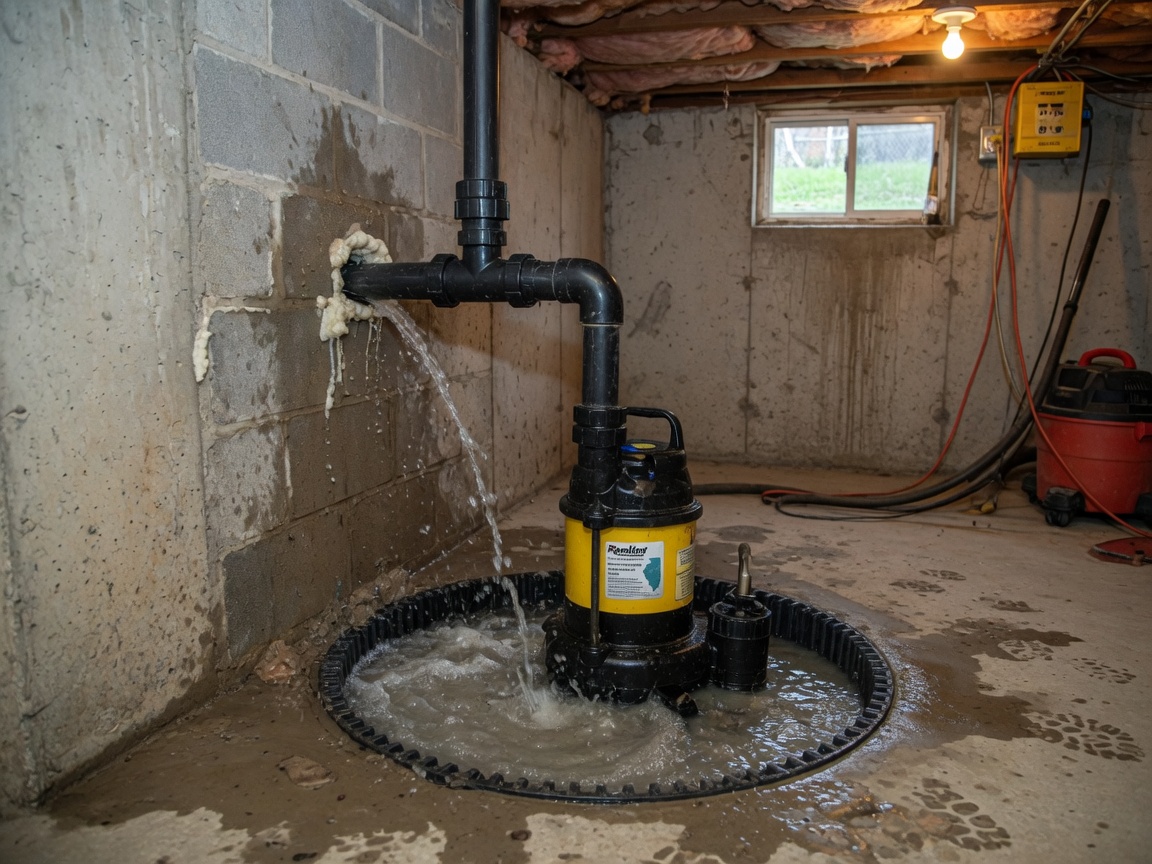
New Milford sits just south of Rockford on the Kishwaukee River, and it is among the flattest ground we work on. Flat ground and a river together produce the hardest discharge problems in our whole service area: the seasonal water table comes up substantially, and there is very little fall available to move the water anywhere once the pump has lifted it. A line laid at minimum pitch here will hold standing water, and standing water in a Rockford January becomes an ice plug that stops the system outright.
The practical consequence is that we spend more time on where the water goes in New Milford than on the pump itself. A daylighted outlet on a flat lot frequently just returns water to the ground a few feet from the foundation, from where it travels straight back to the pit. Dry wells and tie-ins to existing yard drainage are usually the better answer, and on larger lots there is often somewhere genuinely suitable to take the line if you are prepared to run it far enough. We would rather quote the longer run than fit a bigger pump to a system whose real problem is that the water never leaves.
Because the margin on these flats is thin, backup provision matters. When the table is up, a pump that stops for a couple of hours has already let water reach the floor, and there is no reservoir of depth to buy you time. Battery backup is the standard recommendation, particularly on properties on private septic and well where a water powered unit is not an option. Septic layout also governs the discharge route, since saturating a drainfield with thaw water is an expensive error that is easy to avoid at planning stage.
Around New Milford
We regularly work near:
- 📍Kishwaukee River
- 📍Blackhawk Springs Forest Preserve
- 📍South Main Street
- 📍Baxter Road
Sump Pump Repair in New Milford — Local Notes
- •Among the flattest ground in the service area, leaving minimal fall for discharge pitch and making ice plugs a routine winter failure.
- •Daylighted outlets on flat lots often return water to the ground near the foundation, where it travels straight back to the pit.
- •Dry wells or yard drainage tie-ins generally outperform surface outlets here, as do longer runs on larger lots.
- •Thin margins during water table rise mean a pump stopping for two hours puts water at floor level, making battery backup standard.